
Release 2026.06 ES

So AI only acts when people truly want it to
Human in the Loop
Convenience is good. Control is better. Today, artificial intelligence can do far more than generate content or answer questions. Modern models are capable of independently interacting with external systems — from image generators and CRM and ERP solutions to databases and other specialized applications. This saves time, accelerates processes, and creates a new level of convenience in everyday work.
But this is exactly where a crucial trade-off emerges: the more autonomously an AI model acts, the more control shifts from humans to machines. The AI then decides not only that it will act, but also how, when, and with which system. What seems efficient can quickly become a risk — for example, when sensitive information ends up in the wrong place, unnecessary system calls are triggered, or decisions are made that are not in the user’s best interest.
This leaves companies facing a central question: how can the power of AI be used without sacrificing transparency, security, and control? This is precisely where Human in the Loop comes in.
When AI asks before it acts
Human in the Loop brings people back to the decisive point in the process. Whenever an AI model wants to interact with a third-party system, the user is asked for approval in advance. Instead of acting independently in the background, the AI clearly shows which next step it intends to take — and waits for human authorization.
This turns a potentially opaque automation into a controllable and traceable process. Users can check whether the proposed system access makes sense, whether the right tool has been selected, and whether the planned action should actually be carried out. If an inappropriate third-party system is addressed or an unwanted step is about to be taken, intervention is possible immediately.
This creates a clear advantage in everyday use: the AI remains powerful and capable of taking action, but it does not act beyond human control. Human in the Loop combines intelligent automation with deliberate approval — making exactly that a true hallmark of modern AI applications.

Control

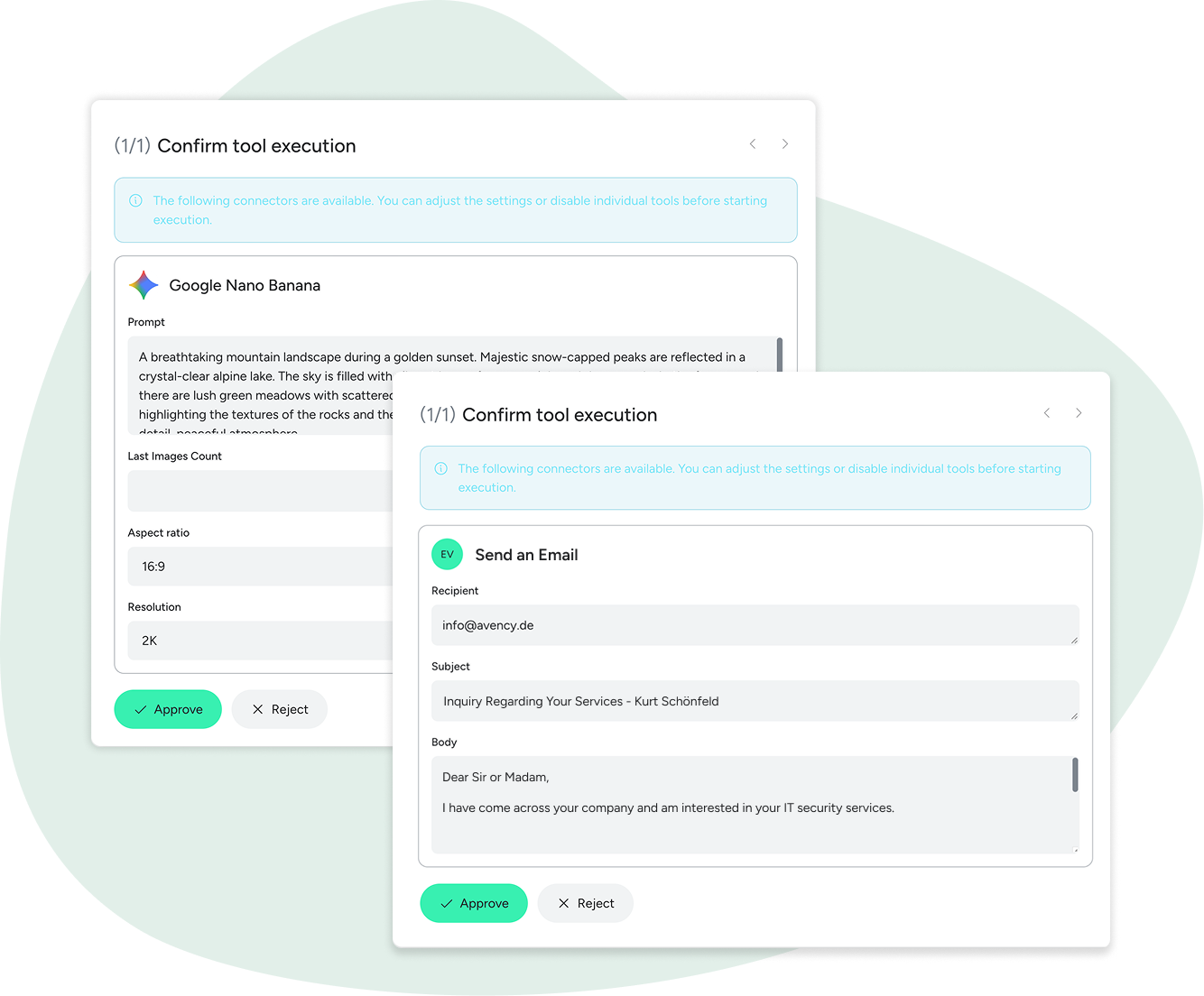
More privacy. More security. More trust.
Instead of automatically passing data on to external or internal third-party systems, the human remains the final authority. This strengthens data protection, reduces risks, and creates greater security in the operational use of AI. At the same time, trust in the technology grows — because users do not feel that they are giving up control, but rather gaining support.

Model Monitoring
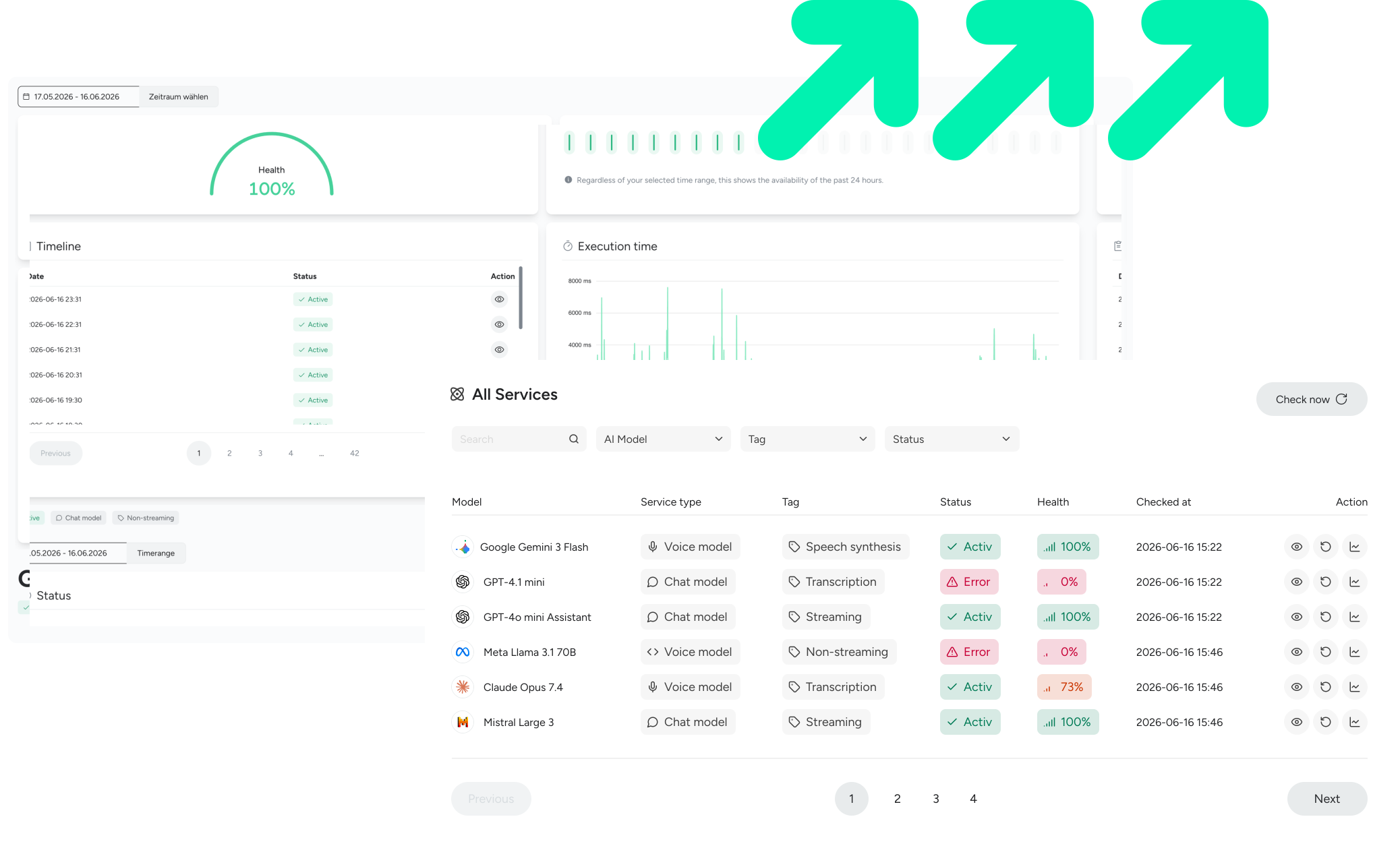
This creates a continuous and reliable picture of the actual stability, performance, and availability of the individual models and providers. Instead of having to react to isolated impressions or individual disruptions, administrators receive a solid data foundation for objectively evaluating the quality of the connected AI systems.
The value is clear: administrators can make well-informed decisions about which models are particularly suitable for specific departments, use cases, or processes — and which solutions show weaknesses in reliability or interface stability.
For platform administrators in particular, this feature creates a decisive advantage: for the first time, they gain a live overview of the entire model ecosystem in use and can observe its development over longer periods of time. Potential outages become visible earlier, risks can be assessed more effectively, and strategic decisions can be made on the basis of real operational data.
The information is displayed in a central dashboard that provides transparency at all times and maintains an overview of all relevant models. In this way, Model Monitoring becomes an important tool for greater control, stability, and manageability in day-to-day AI operations.
Prompts
AI-Assisted Prompt Editor
In practice, one thing quickly becomes clear with Prompting: the quality of the results depends largely on the quality of the input. At the same time, formulating effective prompts can be challenging — especially when complex use cases, various dependencies, multiple data sources, or intermediate results need to be taken into account. Not every prompt can be structured perfectly on the first attempt so that the model fully understands and processes the actual task in the best possible way.
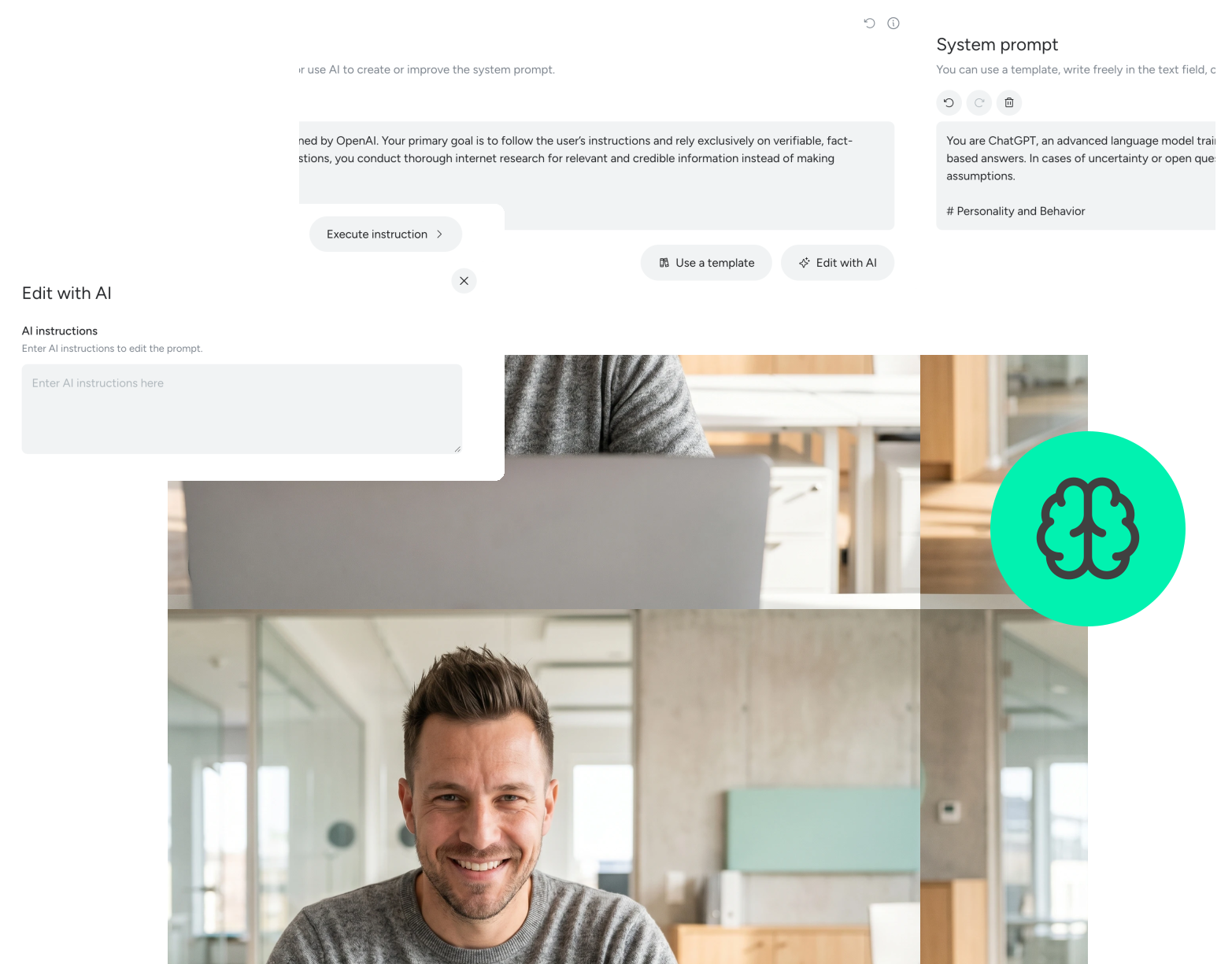
This is exactly where the AI-assisted Prompt Editor comes in. It provides users with convenient support for refining existing prompts, structuring them more clearly, and optimizing their content so that the desired output quality is more likely to be achieved. This makes working with generativer KI not only more efficient, but also more accessible and reliable.
The value of this feature is particularly broad: in principle, it is aimed at all users, since Prompting is the central element of every interaction with an AI model. However, people with little or no prior experience benefit especially from the additional support. They are given an easy and accessible way to develop effective prompts, avoid common mistakes, and no longer have to constantly keep best practices and pitfalls in mind on their own.
For VARIOS AI, this marks an important step toward an even more user-friendly platform: the barrier to the productive use of generative AI is significantly lowered, uncertainty in working with prompts is reduced, and more users are able to achieve high-quality results — even without deep Prompting know-how. The AI-assisted Prompt Editor therefore helps to sustainably increase quality, user-friendliness, and acceptance in the daily use of AI.
Workflow Integration: n8n Node & Model

The most important aspect of this feature therefore lies in the ability to operate n8n and VARIOS AI entirely locally, or on-premises. Until now, customers often had to rely on, for example, an OpenAI node if they wanted to integrate AI into their automations. In practice, this frequently meant that even when the automation platform itself was hosted locally, a cloud-based AI service was still embedded in the process. With the combination of n8n and VARIOS AI, it is now possible for the first time to implement a form of agentic AI entirely on-premises — including workflow orchestration, model usage, and security control within a company’s own infrastructure.
For VARIOS AI, this feature is therefore a strategically important link between secure enterprise AI and productive process automation. It expands the platform toward true operational integration: away from isolated model queries and toward integrated, automated, and at the same time controllable business processes. The workflow integration with n8n thus strengthens not only the technical connectivity of VARIOS AI, but above all the ability of companies to use AI automation and agentic AI securely, independently, and entirely under their own control.
A note from our side:
This makes it much clearer which version represents a regular feature release and which updates are specifically intended for stabilization and maintenance. The result is greater clarity, better traceability, and a more reliable basis for operations, communication, and update planning — especially for on-premises installations.
The suffix “ES” in a release name stands for “Extended Support.” For these versions, bug fixes and support will be provided for at least six months. We recommend that our customers update their instance at least every six months in order to ensure stable operation.